
Issued: 29 October 2026.
On 23 October the member states’ ambassadors agreed the Council’s mandate for negotiations on the 28th regime, after three compromise texts in three months. The mandate, ST 14376/26, is public. It runs to 191 pages, marked against the Commission’s proposal, with every change since March in bold or struck through. Parliament is now the side without a position. Its Legal Affairs Committee has not voted, and talks between the two cannot start until it does.
This piece reads the public record on procedure 2026/0074(COD) as it stood on 28 October 2026. It covers what the Council’s mandate keeps, cuts and tightens on registration, stock options and employee participation, and what Parliament still has to do.
In this piece
- The Council keeps registration in 48 hours and drops the central register
- Stock options stay, but the tax rule now stops at 750 employees
- Employee participation follows the registered office, with an opt-in for host countries
- Parliament’s Legal Affairs Committee is now the step the year-end date waits on
- Sources
The full timeline, with every document and its source link, is on the progress tracker.
The Council keeps registration in 48 hours and drops the central register
The parts a company would meet first are the registration and share rules. The mandate keeps fast-track registration within 48 hours, not counting weekends and public holidays, at no more than EUR 100, for a company using the standard articles of association (Article 16). Around that, it removes and adds:
- Out: the central register and Chapter X on insolvency. The EU central interface, the online front door to the national business registers, stays.
- Tighter checks: member states may delay or refuse registration on money-laundering, terrorist-financing or other criminal grounds, and a new Article 103a lets authorities act against a company that is a “wholly artificial arrangement”, a shell set up to get around the law.
- A weaker share register: in Article 53 the words “have constitutive effect and” are struck through. An entry in the digital register no longer decides who owns a share. It is evidence of ownership and binds the company, and correcting a wrong entry is left to national law (Article 54(5a)). Payment for shares has to go through a bank or payment provider (Article 58(2a)).
- More in the register: Article 54 widens what the register must hold, including tax identification numbers and each shareholder’s share of votes and capital, opens it to public authorities, and lets a company outsource it while its directors stay liable.
- A later start: the rules would apply 21 months after entry into force, against 12 in the Commission’s proposal and 27 in the September compromise text (Article 109).
A LinkedIn post by a notary in Germany focused on some of these changes, starting with the one in Article 53.
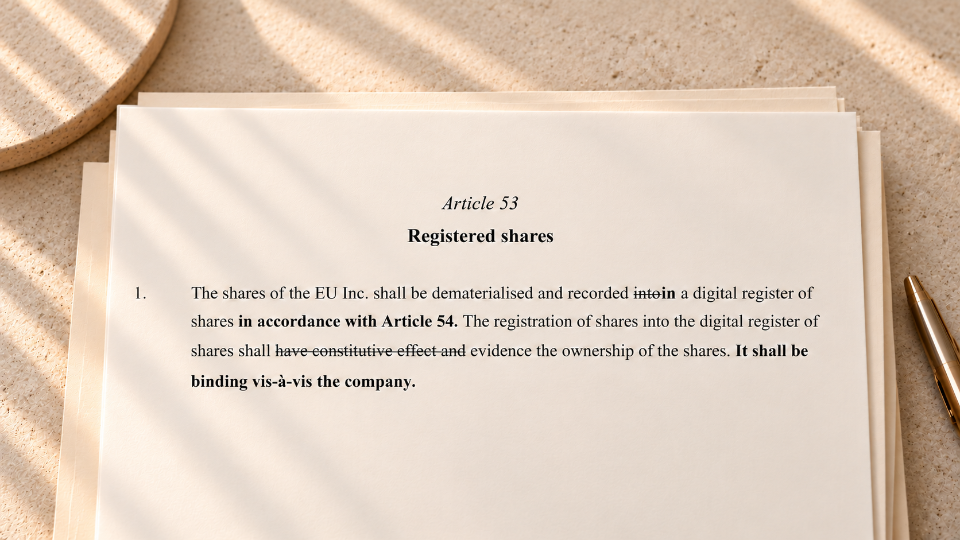
Illustration of Article 53(1) as amended in the Council’s mandate: struck-through words are deleted from the Commission’s proposal, bold words are added. Source: Council document ST 14376/26, page 134.
Not every government that voted for the mandate is content with the rest: Austria, which approved it among the ambassadors, said the same day that a central EU register is still needed (Austrian economy ministry, 23 October).
The Council kept what a founder meets on day one, the speed and the price, and pared back the shared infrastructure that would have made the form work the same way in every country.
Stock options stay, but the tax rule now stops at 750 employees
Any company using the form can still set up an EU employee stock option plan (EU-ESO, Article 78). The tax rule that makes it worth having, tax only when the shares are sold and not when the options are granted or exercised, now applies only where the company had fewer than 750 employees and no more than EUR 150 million turnover when the options were issued (Article 79). The September text drew that line at 1,000 employees and EUR 450 million.
The mandate also keeps national anti-abuse and exit-tax rules in force, and lets a tax authority replace a “manifestly undervalued” sale price with market value. A Council statement will say these tax provisions are an exceptional case and no precedent for other laws. Germany’s startup association, the Startup-Verband, welcomed the agreement but said that successful scale-ups cross the thresholds quickly and lose the advantage when they need it most.
The plan stays open to a company of any size, but its tax advantage is now a rule for smaller companies only.
Employee participation follows the registered office, with an opt-in for host countries
Article 12 keeps the Commission’s model: a company follows the employee participation rules, if any, of the member state where it is registered. Added to it is a rule each member state may choose to switch on (Article 12(2a) to (2d)). Where a company’s branches in that country employ more people on average than its participation threshold, the company has until the end of the following financial year to move those staff into a local subsidiary or give them the participation rights that country’s law requires. Employees can enforce it in that country’s courts.
This is the question Parliament’s political groups have not settled. The committee vote listed for 8 October did not take place, and press reports at the time named employee participation as the open issue.
The Council has written down an answer to the question still dividing Parliament’s groups. The committee vote will show whether they take it as a starting point.
Parliament’s Legal Affairs Committee is now the step the year-end date waits on
The committee meets on 4 and 5 November, but the 28th regime is not on the draft agenda it published on 23 October. Its next listed meetings are on 3, 7 and 10 December. It has the rapporteur’s draft report, PE790.143, and 1,418 members’ amendments, numbered 247 to 1664. The procedure file, 2026/0074(COD), still reads “Awaiting committee decision”, and since 26 October it no longer lists a plenary date. Until then it had shown 12 November. A plenary vote needs the committee’s report first. EU leaders asked on 16 October for negotiations to be concluded by the end of the year.
The Council’s working party has meetings listed for 6 and 13 November and 8 December. A session set for 29 October no longer appears on the Council’s calendar, and the Council has not said what the remaining meetings will cover. Every date, with its source, is on the progress tracker.
We will be tracking three things next. First, whether the Legal Affairs Committee puts the 28th regime on an agenda before its December meetings, and what it does with employee participation. Second, the Council’s statement on the tax provisions, now in draft. Third, when Parliament’s plenary vote is rescheduled. The first decides whether talks can open before the end of the year.
The Council has done its part. The next move belongs to one committee in Parliament.
The newsletter
Follow the 28th regime from the documents
We track procedure 2026/0074(COD) through the Council working party, the committee amendments and the Commission’s own papers, and say what each change means in practice. This piece went out to subscribers on the morning of 29 October 2026.
Subscribe on the28thregime.euSources
- Council of the EU, press release, 23 October 2026, “EU Inc: Council adopts position on a new EU corporate law for innovative companies”
- Council document ST 14376/26, 19 October 2026, “Mandate for negotiations with the European Parliament”: note paragraphs 13 to 16 and Annex Articles 12, 16, 53, 54, 58, 78, 79, 103a and 109
- Council document ST 14376/26 ADD 1, 23 October 2026, “Draft Statement by the Council”
- Council notice CM 4574/1/26 REV 1, Permanent Representatives Committee (Part 1), 21 and 23 October 2026
- Council document ST 12824/26, 7 September 2026, “Second Presidency compromise text”: Articles 79 and 109
- Council meeting pages, Working Party on Company Law: 370801 (6 November), 370884 (13 November), 371811 (8 December)
- Legal Affairs Committee, draft agenda for 4 and 5 November 2026, JURI_OJ(2026)11-04_1, PE797.360
- Procedure file 2026/0074(COD), Legislative Observatory, read 28 October 2026 (no plenary date listed since 26 October)
- Draft report PE790.143 and amendments submitted in committee, PE791.127, PE791.128, PE791.129, PE791.130 and PE791.131
- European Council conclusions, 16 October 2026, point 3
- Startup-Verband, statement by Christoph J. Stresing, 23 October 2026
- Austrian Federal Ministry of Economy, Energy and Tourism, press release on EU Inc., State Secretary Elisabeth Zehetner, 23 October 2026