EU Inc. after the EESC conference
Issued: 27.04.2026
The worker and governance questions are coming into clearer view. After the 21 April EESC conference and the 27 April Council session, the public picture is sharper: three Council meetings held, three more already on the calendar, and a clearer debate about what must be protected if EU Inc is to work.
This edition looks at the conference, the Council rhythm through June, and what the European Parliamentary Research Service says about the legal route behind the proposal.
In this edition:
- The EESC conference, where the strongest pro-case for EU Inc and the main labour-law objections were both stated clearly
- In the Council, three sessions held and three more visible through 2 June
- The EPRS briefing, what Article 114, Article 50, and the treaty choice actually mean
- What to watch, the 7 May session, the JURI rapporteur, and the June runway
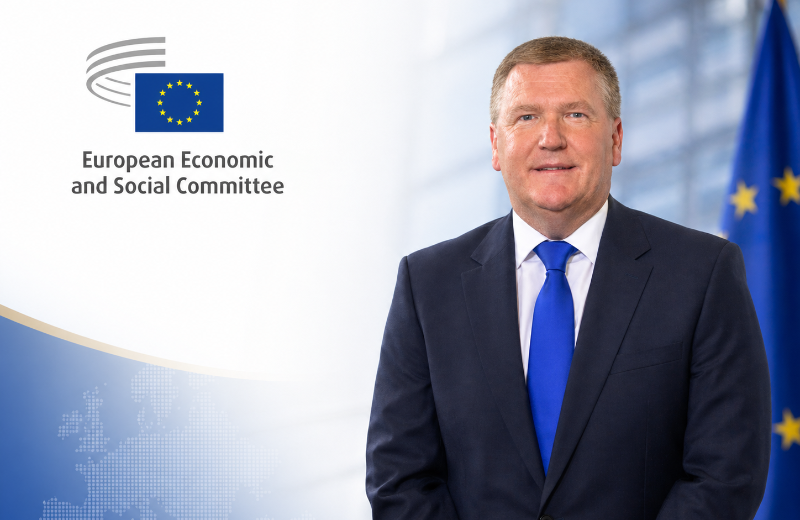
Michael McGRATH, Commissioner for Democracy, Justice, the Rule of Law and Consumer Protection - video message, 21 April 2026. EESC Workers' Group.
Excerpt on YouTube | Morning session | Afternoon session | Programme
© European Union, 2026. Source: European Economic and Social Committee (EESC) | youtube.com/@EESCWorkersGroup
The EESC conference
The Workers' Group of the European Economic and Social Committee, together with the ETUC, organised “28th Regime, Why are alarm bells ringing?” on 21 April 2026 in Brussels. It was the first major institutional event devoted entirely to the worker, governance, and labour-law dimension of EU Inc., and it made the debate much more usable: not simply whether Europe needs a simpler cross-border company form, but what safeguards have to sit inside it.
The strongest positive case was stated clearly. Michael McGrath's opening line was that competitiveness cannot come from weaker protection for workers. It has to come from productivity, skills, and fairer markets. The Commission side, reinforced by DG JUST's Hubert Gams, presented EU Inc. as a practical single-market tool: digital-by-default incorporation, once-only registration, simpler cross-border operation, easier investment mechanics, an EU-level stock-option framework, and a more usable path through insolvency for part of the target group. The Commission's core reassurance remained the same throughout the day: national labour rules still apply to EU Inc. companies.
The constructive institutional case went further than that. Antonio Garcia del Riego gave the cleanest pro-EU Inc framing: this should be judged against a founder's domestic company form, not against the most permissive structure somewhere else in Europe. In that reading, EU Inc. is a market-integration tool, not a deregulation tool. Enrico Letta backed the concept in principle while insisting that worker protection and social dialogue cannot be traded away for speed. Joaquin Perez Rey added a practical counter-argument to the race-to-the-bottom logic: Spain strengthened labour protections, raised minimum wages, and still improved competitiveness. The message from that side of the room was not that simplification is wrong, but that simplification has to be designed on top of enforceable protections.
The harder arguments were mostly about design risk, not about denying the need for reform. The labour-side criticism concentrated on a few concrete points: whether the legal basis is robust enough for a company form like this, whether the split-seat model creates an opening for regulatory arbitrage, and whether the operative text does enough to stop abuse rather than merely assume good behaviour. That matters because it suggests the political battle will be about how EU Inc. is built, not simply whether it exists.
The SE shelf-company precedent is the most concrete warning on the table. Markus Meyer-Erdmann argued that the existing Societas Europaea already shows how cross-border company forms can be used to sidestep worker-participation rules. His point was not abstract. If a regime lets a company register in one member state and operate mainly in another, and if collective-rights safeguards are left too weak in the operative text, the incentive to choose the easier jurisdiction will be real.
The central gap remains collective rights. Individual labour protections such as wages, working time, health and safety, and equal treatment are easier to trace through existing national and EU rules. Collective rights are harder. Collective bargaining, information and consultation, and board-level worker representation still track the law of the registered office more than the place of work. That is why the split-seat model keeps coming back as the live issue. If EU Inc. is to become a credible and durable label, this is where the legal drafting pressure will concentrate.
The broader takeaway is useful, not fatalistic. The conference did not show that EU Inc. cannot work. It showed that the debate has moved beyond slogans. The pro-case is now clearer, the counter-arguments are more concrete, and the file is entering the stage where technical safeguards, not just political branding, will decide whether the proposal becomes workable.
The afternoon widened the frame further: several speakers argued that Europe still needs answers on energy costs, industrial competition, capital access, and quality-jobs policy alongside company-law reform. That matters because EU Inc. is now being judged as one instrument in a larger competitiveness package, not as a standalone fix.
In the Council
The Working Party on Company Law has been meeting roughly every two weeks since late March. Three sessions have now been held, and three more are visible on the public calendar through 2 June. That rhythm matters more than any single agenda line: the file is under steady technical examination, but public transparency is still thin. No readout or negotiating text from the first three sessions has appeared yet.
| 23 March 2026 | Held |
| 17 April 2026 | Held |
| 27 April 2026 | Held |
| 7 May 2026 | Scheduled |
| 18 May 2026 | Scheduled |
| 2 June 2026 | Scheduled |
The EPRS briefing
The European Parliamentary Research Service, Parliament's in-house research arm, published a 9-page briefing on the EU Inc. proposal in April. It is the clearest short institutional summary of where the legal and political choices now sit.
The legal instrument. TFEU means the Treaty on the Functioning of the European Union, one of the core EU treaties that tells the institutions which legal bases they can use. Article 114 is the internal-market harmonisation clause: it is used when the EU wants to align national rules that affect how the single market works. Article 50 is the more specific company-law base tied to freedom of establishment and the coordination of national company rules. Parliament's January resolution pointed to Articles 50 and 114 together and preferred a Directive. The Commission chose a Regulation based on Article 114 alone. That matters because a Regulation applies directly and uniformly across the EU, while a Directive sets common objectives but still has to be transposed into national law. So the legal-basis question is not technical window dressing. It shapes how uniform the regime would be and how exposed it may be to challenge.
Where stakeholders stand. BusinessEurope supports the proposal and welcomes the exclusion of labour law from scope. ETUI, the European Trade Union Institute and the research arm of the European trade union movement, calls the proposal unnecessary and potentially harmful to labour rights. Allied For Startups supports the concept but notes that important design choices are deferred to implementing acts. Martin Sandbu, a Financial Times economics commentator who has argued in favour of a workable EU-wide startup framework, supports the direction in principle while warning that cross-border enforcement still leans heavily on national courts.
Political priority. The European Council of 19 March 2026 placed the 28th regime first among the high-priority competitiveness measures, with a target of co-legislator agreement by the end of 2026. The EPRS also underlines an important tension: political urgency is high, but Parliament's own January position was more cautious about the proposal's chances of success and more explicit on safeguards.
What to watch
- Session 4, 7 May. After three held sessions and no public readout, the next question is whether the Council process stays publicly silent or whether the first real negotiating clues start to surface.
- The JURI rapporteur. JURI remains the lead Parliament committee, and the rapporteur assignment still matters because that person will shape Parliament's first structured negotiating position on the file.
- The June runway. Sessions on 18 May and 2 June show that the Council is settling into regular technical work. That is the bigger signal: the proposal is moving procedurally even while the substance remains mostly behind closed doors.
The progress page tracks each Council session, Parliament signals, and primary-source updates in one place.
Open the progress trackerSources
We will track the Council briefings, go deeper into the proposal and supporting documents, and follow up with shorter focused newsletters on the legal text, the founder implications, and the wider 28th-regime path.
If this work is useful, please share the newsletter and the website with other founders, startup operators, legal advisers, investors, and policymakers following the file.
Thanks for the support!