Inside the proposal: what the documents say

Inside the proposal: what the documents say, what the community thinks, and what comes next
|
|
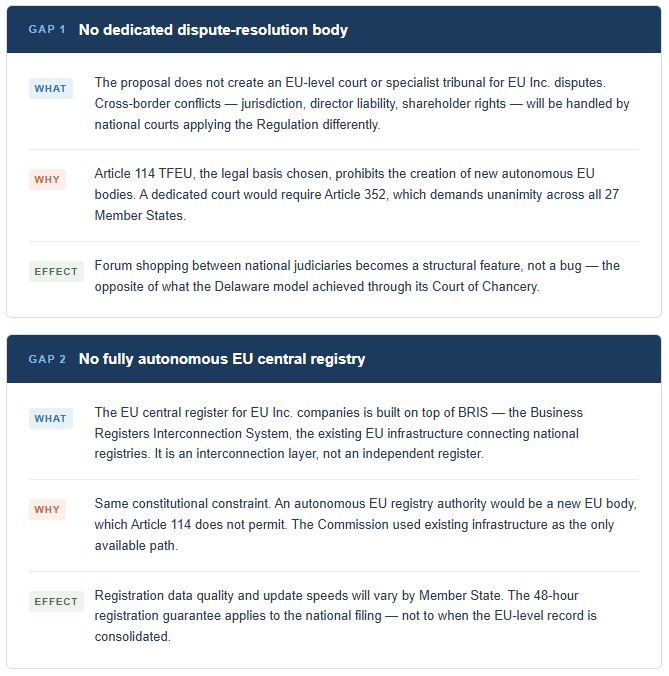
Gap 1: Disputes go to national courts. 27 Member States, 27 possible interpretations of the same Regulation. No EU-level court, no mandatory arbitration.
Gap 2: Registration routes through national business registers underneath the EU central interface. The quality, speed, and digital maturity of those registers vary.
The question is: why?
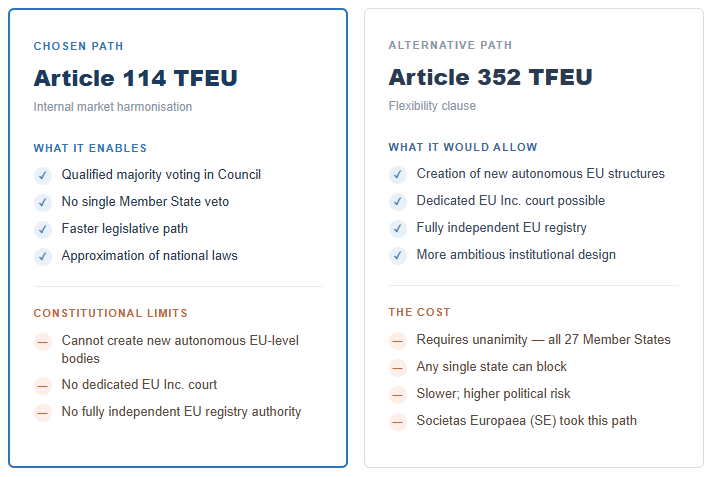
The answer is Article 114 TFEU — the legal basis the Commission chose for this proposal.
Article 114 is the internal market harmonisation provision. It allows the EU to approximate national laws to improve the functioning of the Single Market. Critically, it enables qualified majority voting in the Council, which means the proposal cannot be blocked by a single Member State. This is why the Commission chose it — speed.
But Article 114 has constitutional limits. EU case law makes clear that it cannot be used to create entirely new autonomous EU-level bodies — like a dedicated EU Inc. court or an independent EU registry authority. Previous EU company forms like the Societas Europaea (SE) were based on Article 352 TFEU, which does allow the creation of new structures — but requires unanimous agreement from all 27 Member States. That path is slower and politically harder.
The trade-off is now visible. The Commission chose the faster legal path (Article 114, qualified majority) at the cost of a narrower scope (no new EU court, no fully autonomous registry). The alternative — Article 352 with unanimity — would have allowed a more ambitious design but risked the proposal being blocked or delayed for years.
This is not a political failure or a lobbying outcome. It is a constitutional constraint built into the EU treaties. Understanding it matters, because it also defines what kind of fixes are realistic during the legislative process — and which ones would require treaty change.
What the ecosystem is actually debating
We tracked the public discussion across founder, investor, legal, and policy circles since 18 March. No names or companies below.
"27 versions of a unified law"
The most common reaction. The concern: if registration and disputes are still handled nationally, the EU Inc. label changes the form but not the experience. Phrases like "rebranding of the status quo" and "new paint on an old broken car" capture the tone. For many, the value of EU Inc. depends entirely on whether it delivers a genuinely uniform experience or reproduces existing fragmentation under a common name.
The Delaware comparison is more nuanced than it appears
A significant part of the discussion draws on the US model — and the views split.
For context: Delaware is a small US state that became the default incorporation home for most American companies, including the majority of VC-backed startups. Not because they operate there, but because it offers a specialised commercial court with decades of predictable case law and a legal framework that investors and lawyers across the world know how to work with — the product of competition between US states, not federal mandate.
One side of the EU Inc. discussion argues the US comparison actually supports the proposal as written. The US has no single national company registry either — Delaware is one of 50+ state options, and founders freely incorporate there regardless of where they operate. Under this reading, EU Inc. could trigger a similar dynamic in Europe, with the most legally efficient Member State becoming the preferred home for EU Inc. companies.
The other side counters: Delaware works because of the court, not despite the fragmentation. Without a single, predictable legal venue for EU Inc. disputes, the analogy does not hold.
Both sides have a point. The proposal does not resolve this tension — the legislative process might.
Operational reality vs. incorporation on paper
Several practical questions surface repeatedly. Does the 48-hour registration window actually deliver a working tax ID, VAT number, and bank account — or just a company on paper? Will national startup incentives (grants, tax credits, innovation vouchers) apply to EU Inc. structures? Does the proposal address day-to-day operations — hiring, compliance, tax filing — or only the act of incorporating?
The proposal covers incorporation and corporate lifecycle. It does not harmonise tax, employment, or operational compliance. Those remain national. This is by design — but it is a gap that founders will feel in practice.
The capital and governance chapters deliver
Not everything is criticised. The EUR 0 capital requirement, the explicit SAFE enablement, digital share transfers without notary, multiple share classes, and the EU-ESO scheme with deferred taxation are all welcomed — sometimes enthusiastically. These respond directly to what the VC-backed startup ecosystem has been asking for, and they represent real progress over most national company forms.
The EU central register — a late addition
Multiple observers have noted that the EU central register was not in the earlier leaked drafts. It appears to have been added or significantly strengthened between the leaks and the published text. This matters: it suggests that feedback during the consultation phase had a measurable effect on the final proposal. The process is not static.
Legal realism
Legal professionals in the discussion independently confirm the Article 114 constraint described above. Several note that forcing Member States to remove company registration from their court systems — particularly in Germany and Austria, where this is constitutionally anchored — would have been legally and politically impossible. This does not make the gap less real. But it explains why the Commission made the choices it did, and it sets realistic expectations for what the co-legislators can change.
The legislative track
What happened:
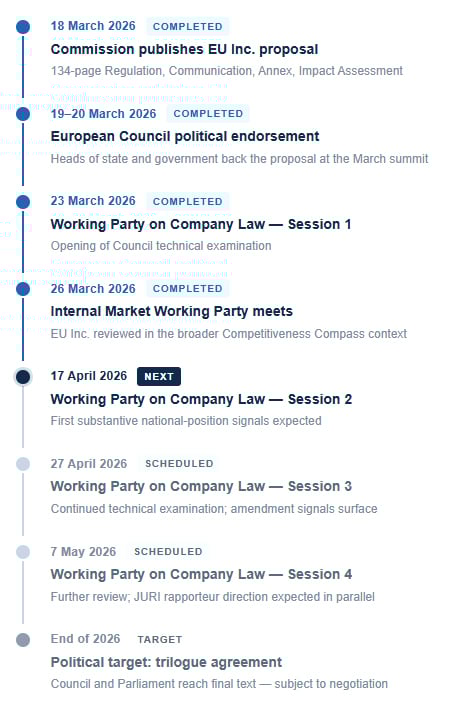
Following the Commission proposal on 18 March and the European Council's political endorsement on 19–20 March — covered in our last two editions — the Council moved into technical examination.
23 March — The Council's Working Party on Company Law met for the first time on the proposal. This was the opening session of the Council's technical examination — the stage at which Member States begin reviewing the text through their working-party representatives.
26 March — The Internal Market Working Party also met on the file, in the broader context of the Single Market and Competitiveness Compass package.
What comes next:
17 April, 27 April, 7 May — Three further Working Party on Company Law sessions are listed in the Council calendar. These are where substantive engagement begins. National positions, red lines, and early amendment signals should start to surface across these sessions.
European Parliament — JURI committee has the file. Rapporteur assignment and the first substantive committee discussion will set Parliament's direction. This is one of the key signals to watch.
Spring 2026 — Draft merger guidelines expected for consultation (a parallel competitiveness track, separate from EU Inc.).
End of 2026 — Political target for trilogue agreement.
The text that enters trilogue will not be the same text published on 18 March. What changes — and what survives — depends on what happens in these sessions.
Where things stand
The EU Inc. proposal is real, detailed, and more substantial than many expected. The capital and governance chapters respond directly to what the ecosystem has been asking for. The choice of a Regulation (not a Directive) and the EU central register are meaningful design decisions.
The dispute-resolution gap and the reliance on national registries are genuine limitations. They are also, in significant part, a consequence of the legal basis chosen and the constitutional architecture of the EU. That does not make them less important — but it does change what kind of fix is realistic during the legislative process.
The announcement phase is over. The proposal is now with the co-legislators. The working-party sessions starting 17 April will be the first real indication of where Member States stand, and Parliament's JURI committee will shape the other half of the negotiating position. The text that enters trilogue will not be the text published on 18 March.
Official sources:
- EU Inc. document hub: https://commission.europa.eu/topics/business-and-industry/doing-business-eu/company-law-and-corporate-governance/eu-inc-new-harmonised-corporate-legal-regime_en
- Q&A on EU Inc.: https://ec.europa.eu/commission/presscorner/detail/en/qanda_26_615
- European Council conclusions, 19 March 2026: https://www.consilium.europa.eu/en/press/press-releases/2026/03/20/european-council-conclusions/
- Working Party on Company Law: https://www.consilium.europa.eu/en/meetings/mpo/2026/3/wp-on-company-law-(365509)/
- EU Inc. proposal (PDF): https://commission.europa.eu/document/download/3e9822aa-8cef-40a1-904e-a53fc68e7265_en
- Legislative procedure file: https://oeil.europarl.europa.eu/oeil/en/procedure-file?reference=2025/2079(INL)
- Article 114 TFEU: https://eur-lex.europa.eu/eli/treaty/tfeu_2008/art_114/oj/eng